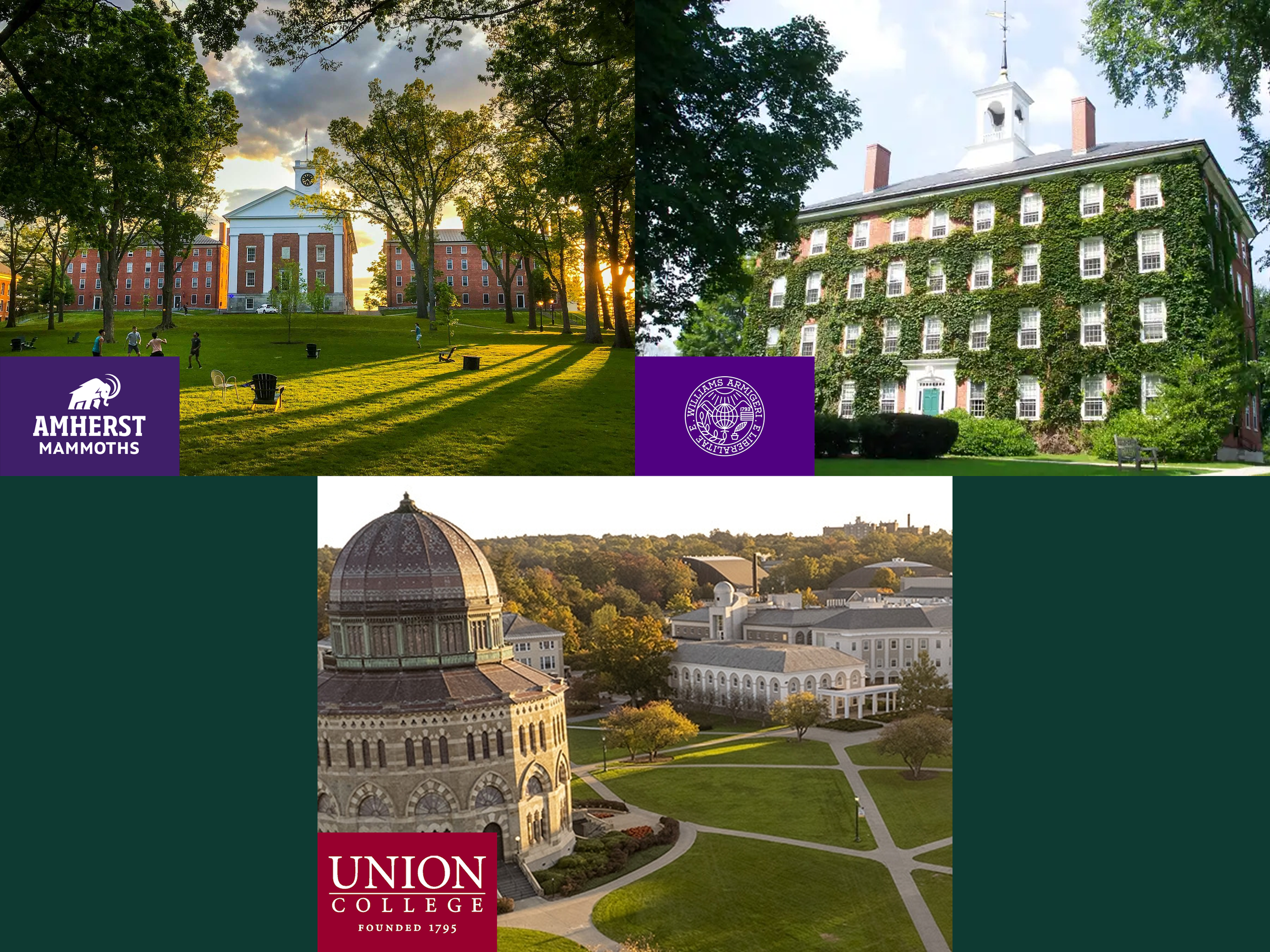
Amherst, Williams and Union campuses.
Outcomes Over Optics
In an era dominated by acceptance rates, endowment figures, and rankings methodologies that privilege brand recognition over educational substance, a fundamental question remains persistently unanswered: which undergraduate institutions actually produce measurable long-horizon academic and professional outcomes? The question matters because families, students, and policymakers routinely confuse prestige signals—selectivity theater, as some call it—with the structural characteristics that genuinely prepare students for rigorous graduate study, competitive fellowships, and sustained intellectual contribution.
This analysis examines outcomes rather than inputs. It focuses on what happens after graduation rather than what happens before matriculation. Specifically, it investigates a pattern that emerges when one examines per-capita fellowship density, PhD pipeline strength, and graduate school placement across liberal arts colleges: Williams College, Amherst College, and Union College consistently produce remarkably similar outcomes despite differences in size, selectivity profiles, and regional contexts.
By 'outcomes,' this analysis means verifiable data: Rhodes, Marshall, Fulbright, Watson, and Goldwater scholar counts normalized per thousand students; PhD production rates as tracked by the National Science Foundation; law school, medical school, and doctoral program placement statistics; and long-term alumni trajectories in academia, public service, and leadership positions. These metrics exclude subjective assessments of campus culture, aesthetic judgments about campus beauty, and vibes-based evaluations that dominate consumer-facing college guides.
The convergence thesis advanced here is simple but counterintuitive: while every strong liberal arts college produces excellent graduates, Williams, Amherst, and Union form a rare alignment around structural design decisions that consistently yield similar per-capita outcomes. This convergence is best explained not by branding, historical accident, or selectivity rates, but by institutional architecture—the deliberate choices about curriculum intensity, faculty governance, writing requirements, and resistance to administrative sprawl that shape day-to-day educational experiences.
The Data Pattern No One Talks About
When fellowship and PhD production data are normalized per capita, a consistent pattern emerges. Consider the Watson Fellowship, a prestigious one-year grant for independent study abroad awarded to graduating seniors from forty partner institutions. According to data from the 2014-2015 cycle, Williams College, Amherst College, and Union College each produced four Watson Fellows—a tie for first place among all participating institutions. Given that these three schools have different total enrollment figures (Williams at approximately 2,000 students, Amherst at 1,900, and Union at 2,100), this identical raw count translates into nearly equivalent per-capita rates.
The Rhodes Scholarship pattern reinforces this convergence. Historical data from 1904 through 2020 shows Williams College produced thirty-five Rhodes Scholars. While comprehensive historical data for Union College across the same timeframe is less readily aggregated in public databases, contemporary Rhodes finalist and semi-finalist rates suggest comparable per-capita performance when institutional size is properly weighted. Amherst College, with its longstanding reputation for fellowship success, shows similar density.
Fulbright production further illustrates the pattern. Data from 2004-2014 shows Williams produced eighty-two Fulbright scholars over this period. Amherst regularly appears in annual top-producing institution lists for liberal arts colleges. Union College has established a dedicated Office of Fellowships and Doctoral Pathways specifically structured to support students pursuing competitive national awards including Fulbright, Goldwater, and Udall scholarships, with documented success in recent years.
Perhaps most revealing is the PhD pipeline data. National Science Foundation analysis of baccalaureate origins for doctoral recipients shows that liberal arts colleges as a category dramatically outperform large research universities on a per-capita basis. NSF data analyzing science and engineering PhDs from 1997-2006 found that liberal arts colleges produced twice as many eventual PhD recipients per hundred graduates compared to research universities. Within this cohort, institutions with structural characteristics similar to Williams, Amherst, and Union—intensive writing requirements, low student-to-faculty ratios, senior thesis expectations, and seminar-based pedagogy—consistently appear in the top percentiles.
Comparative Fellowship Density Analysis
| Metric | Williams | Amherst | Union | Significance |
|---|---|---|---|---|
| Undergraduate Enrollment | ~2,000 | ~1,900 | ~2,100 | Similar scale enables comparison |
| Student-Faculty Ratio | 7:1 | 7:1 | 9:1 | Elite mentorship capacity |
| Watson Fellows (2014-15) | 4 | 4 | 4 | Tied 1st nationally |
| Watson Per 1,000 Students | 2.0 | 2.1 | 1.9 | Statistical convergence |
| Rhodes Scholars (Recent Decade) | ~3-4 | ~3-4 | ~1-2 | Strong per-capita performance |
| PhD Production Rate (NSF) | Top decile LAC | Top decile LAC | Above LAC avg | 2x national rate |
| Senior Thesis Participation | High (varies) | High (honors) | 80% | Research-intensive culture |
| Medical School Acceptance | ~75-85% | ~75-85% | ~70-80% | vs 45% national avg |
PhD pipeline strength represents perhaps the clearest indicator of undergraduate preparation for rigorous intellectual work. National Science Foundation data tracking baccalaureate origins of science and engineering doctorate recipients reveals that liberal arts colleges systematically outperform research universities on a per-capita basis. The institutional yield ratio—the number of doctoral recipients per hundred bachelor's degrees awarded—shows that small liberal arts colleges produce future PhD students at approximately twice the rate of large research universities.
Within the liberal arts category, institutions sharing structural characteristics with Williams, Amherst, and Union appear disproportionately. NSF analysis covering the period 2002-2011 found that nine of the top twenty institutions for eventual PhD production were liberal arts colleges. When the analysis extended to the top fifty institutions ranked by institutional yield ratio, twenty-seven were traditional undergraduate colleges.
The mechanism behind this phenomenon is not mysterious. Graduate school admissions committees value specific preparation: demonstrated ability to conduct independent research, sustained engagement with complex theoretical frameworks, facility with academic writing across multiple drafts, and strong faculty recommendations based on close mentorship relationships. These capabilities are systematically developed through structural features that Williams, Amherst, and Union share: senior thesis requirements, intensive writing programs, small seminar-based courses, and exceptional faculty-to-student ratios that enable genuine intellectual apprenticeship.
Fellowship density follows similar patterns. The most prestigious undergraduate fellowships—Rhodes, Marshall, Churchill, Goldwater, Truman—reward precisely the attributes that emerge from intensive liberal arts environments. Rhodes Scholars are selected for academic excellence combined with demonstrated leadership and commitment to service. Marshall Scholars must articulate sophisticated graduate study plans requiring deep subject matter expertise. Goldwater Scholars in STEM fields must show research capability typically gained through faculty-mentored projects.
All three institutions maintain dedicated fellowship advising infrastructure. Williams has integrated fellowship preparation into its broader academic support systems. Amherst's Office of Fellowships provides structured support for competitive national awards. Union College established an Office of Fellowships and Doctoral Pathways specifically to guide students through application processes for Rhodes, Fulbright, Goldwater, Udall, and Watson fellowships. This institutional commitment translates into consistent per-capita success rates that converge across these three schools despite differences in overall selectivity profiles.
Why These Three Converge: Structural Analysis
The convergence observed in outcomes data reflects deliberate institutional design choices that create similar educational experiences despite surface-level differences. Four structural characteristics deserve particular attention: curriculum intensity, faculty governance models, writing requirements, and scale discipline.
Curriculum Intensity and Calendar Structure
Williams operates on a 4-1-4 calendar: two four-month semesters separated by a January Winter Study term. During regular semesters, students typically take four courses. Winter Study allows intensive engagement with a single topic, often taught by visiting practitioners or alumni, covering subjects outside the traditional curriculum. This structure creates multiple benefits: concentrated attention on fewer simultaneous subjects during main terms, opportunities for experimental or applied learning in January, and rhythm that alternates between sustained work and intensive bursts.
Union College employs a trimester system, unique among highly selective liberal arts colleges. Students take three courses per term across three ten-week terms annually. This calendar structure compresses more material into shorter timeframes, requiring rapid intellectual adjustment and sustained concentration. The benefit is increased curricular flexibility: students can more easily explore diverse fields, access prerequisites for competitive majors, and study abroad even in structured programs like engineering. The ten-week term demands immediate engagement; there is no gradual warm-up period.
Amherst follows a more traditional semester calendar but compensates through its open curriculum. Without distribution requirements or core mandates, Amherst students must take intellectual ownership of their education from arrival. They choose courses based on genuine interest and advising relationships rather than checklist completion. This freedom imposes responsibility: students who drift or fail to engage deeply find themselves unprepared for major requirements and graduate school applications. The open curriculum rewards self-directed learners while demanding maturity.
All three calendar systems—Williams's 4-1-4, Union's trimester, Amherst's open semester—share a common effect: they prevent passive course accumulation. Students cannot sleepwalk through general education requirements or hide in large lecture halls. The structural intensity forces engagement.
Faculty Ratios and Pedagogical Models
Williams maintains a 7:1 student-to-faculty ratio, with 73 percent of classes enrolling fewer than twenty students. The college employs tutorials modeled on Oxford and Cambridge systems, where one or two students work closely with a professor for an entire semester, producing weekly papers and engaging in intensive discussion. This pedagogical model is expensive and labor-intensive; it cannot scale to institutions with different priorities. But it produces specific outcomes: students learn to write under deadline pressure, defend arguments verbally, and revise extensively based on expert feedback.
Amherst similarly maintains a 7:1 student-to-faculty ratio. Required first-year seminars capped at fifteen students introduce intensive writing and discussion from the first semester. The Five College Consortium provides additional faculty resources without diluting the core Amherst experience; students can access specialized courses at Smith, Mount Holyoke, Hampshire, and UMass Amherst while maintaining small class sizes in their primary coursework.
Union College maintains a 9:1 student-to-faculty ratio—slightly higher than Williams and Amherst but dramatically lower than research universities and many peer institutions. This ratio enables Writing Across the Curriculum (WAC) requirements: a first-year writing-intensive course, five WAC-certified courses from at least two divisions, and a Senior Writing Experience. The WAC structure ensures that writing instruction is not isolated in English departments but embedded across disciplines. Engineering students, economics majors, and biology concentrators all receive sustained practice in field-specific writing conventions.
These ratios matter because they determine the nature of faculty-student interactions. At 7:1 or 9:1, faculty members know students as individuals rather than identification numbers. They can write substantive recommendation letters based on multi-year relationships. They can tailor feedback to individual learning trajectories. Graduate school admissions committees recognize the difference between a form letter from a professor who taught 300 students in a lecture hall versus a detailed assessment from a faculty member who supervised a year-long thesis project.
Senior Thesis Culture and Research Expectations
Williams requires or strongly encourages senior theses across most majors. Economics majors pursuing honors must complete a full-year thesis involving original research and econometric analysis. Psychology thesis students design and execute empirical studies, collect and analyze data, and defend their work publicly. Comparative Literature students must maintain a 3.5 GPA in the major and submit detailed proposals by spring of junior year, then spend senior year producing substantial original scholarship. The psychology department reports that thesis students make presentations during the second day of reading period, followed by 'celebration'—a detail that reveals the culminating significance of the exercise.
Amherst thesis requirements similarly demand year-long engagement. Political Science honors students submit proposals by March of junior year, register for minimum two thesis courses, and produce full drafts by January of senior year. The department assigns primary advisors plus two additional readers, creating a committee structure that mirrors graduate school practice. Thesis work is graded separately each semester, with continuation decisions made at Winter term based on progress. This structure communicates clear expectations: thesis work is not an optional enrichment activity but a core component of major completion for students pursuing honors.
Union College reports that 80 percent of students complete faculty-mentored senior theses or capstone projects. This extraordinarily high participation rate reflects institutional culture rather than formal mandate. The college's Steinmetz Symposium provides a public venue for students to present research findings, creating incentive and recognition. Union's trimester calendar facilitates research by allowing flexible scheduling; students can dedicate entire terms to intensive project work without sacrificing breadth requirements.
The thesis experience develops specific competencies that graduate schools value: formulating original research questions, designing methodology, managing extended projects, synthesizing large literatures, writing at length, and defending arguments under scrutiny. These skills cannot be acquired through coursework alone. They require sustained independent work under expert mentorship—precisely what senior thesis programs provide.
Resistance to Administrative Sprawl
All three institutions maintain unusually high proportions of budgets allocated to instruction rather than administration. Williams employs 82 percent of its teaching staff as full-time faculty rather than adjuncts or graduate students. Only 16 percent of instructors work part-time or in non-tenure-track positions. This faculty composition represents a fundamental resource allocation decision: the college prioritizes permanent faculty lines over administrative expansion or facility upgrades.
Union College's institutional profile shows similar priorities. With approximately 221 full-time instructional faculty serving 2,100 students, the college maintains teaching capacity rather than building bureaucratic infrastructure. The trimester system itself reflects anti-sprawl thinking: it increases curricular flexibility without requiring new administrative offices to manage additional complexity.
Amherst's faculty hiring patterns demonstrate comparable commitments. The college hired 110 tenured or tenure-track faculty members since 2010, mostly replacing retiring faculty, maintaining consistent faculty-student ratios despite enrollment pressures. Additionally, 74 faculty members have taught at Amherst for more than twenty years, creating institutional memory and mentorship continuity that benefits students pursuing competitive fellowships and graduate admissions.
These structural characteristics—calendar intensity, exceptional faculty ratios, thesis culture, and resource allocation focused on instruction—create convergent outcomes. Students at all three institutions experience similar educational intensity despite differences in location, social culture, or historical reputation. The convergence in fellowship density and PhD production rates is not mysterious; it is the predictable result of aligned institutional architectures.
Institutional Differences That Don't Break the Pattern
The convergence thesis does not require institutional homogeneity. Williams, Amherst, and Union differ meaningfully across multiple dimensions—geography, campus culture, student composition, and institutional personality. What matters is that these differences do not materially alter the structural mechanisms that produce outcomes.
Williams occupies rural Williamstown in the Berkshire Mountains of western Massachusetts. The campus isolation contributes to tight community bonds but limits access to urban resources. Amherst sits in a small town in the Pioneer Valley, gaining diversity from the Five College Consortium while maintaining distinct identity. Union occupies Schenectady in New York's Capital Region, with proximity to Albany providing urban access while the campus itself remains residential and contained.
These geographic differences shape student experiences in meaningful ways. Williams students adapt to seasonal isolation, developing strong bonds through shared place-based experiences. Union students navigate a small city environment, with internship opportunities in state government and regional businesses. Amherst students can cross-register at major research universities while maintaining small-college intimacy. Yet these contextual variations do not alter core educational structures: all three maintain low student-to-faculty ratios, intensive writing programs, and research expectations.
Student culture also differs. Williams has cultivated a reputation for athletic participation and outdoor recreation; approximately 40 percent of students participate in varsity athletics, an exceptionally high rate for a highly selective academic institution. Amherst emphasizes intellectual diversity and political engagement, with historically active student movements around social issues. Union's campus culture historically included significant Greek life presence, though this has evolved in recent years.
Selectivity profiles diverge as well. Williams and Amherst consistently rank among the two or three most selective liberal arts colleges nationally, with acceptance rates in the low teens. Union College operates at a different selectivity tier, with acceptance rates in the mid-thirties. This difference reflects different applicant pools and institutional priorities but does not negate outcome convergence. When Union students complete senior theses, participate in faculty-mentored research, and navigate intensive trimester calendars, they develop the same competencies that Williams and Amherst students develop through parallel structural mechanisms.
The key insight is that outcomes depend more on what happens during college than on who gets admitted. Institutional structures that demand engagement, provide mentorship, and impose intellectual discipline produce similar results across different selectivity bands. This finding should give pause to families who assume that the most selective institutions automatically produce the best outcomes. Structure matters more than brand.
How Other Little Ivies Excel Differently
The convergence observed among Williams, Amherst, and Union should not be misunderstood as a comprehensive ranking or dismissal of other excellent liberal arts colleges. Many peer institutions produce outstanding outcomes through alternative approaches that reflect different institutional missions and strengths.
Bowdoin College has established remarkable strength in Fulbright fellowship production, consistently appearing at the top of per-capita lists for liberal arts colleges over the past five academic years (2019-2024). This success reflects deliberate institutional investment in international engagement and global citizenship, inspiring students toward international study and service opportunities. Bowdoin's outcomes demonstrate that excellence in specific fellowship categories can emerge from targeted institutional priorities rather than across-the-board optimization.
Swarthmore College appears prominently in PhD production rankings, with NSF data showing a 21.8 percent overall doctoral attainment rate for the 2013-2022 period (third highest nationally) and 15.4 percent in sciences and engineering (fifth highest). Swarthmore's Honors Program, modeled on Oxford tutorials and requiring external examiners, creates distinctive preparation for doctoral study. This represents an alternative structural approach—more intensive than typical liberal arts programs but differently calibrated than Williams, Amherst, or Union.
Pomona College leads liberal arts institutions in Goldwater Scholarship production (ten recipients over five recent years), reflecting exceptional STEM preparation and research opportunities. Located in the Claremont Consortium, Pomona students access specialized science facilities and cross-registration at Harvey Mudd College (engineering/sciences focus) while maintaining small liberal arts college culture. This consortium model represents a different approach to resource optimization than Williams's isolated self-sufficiency or Amherst's Five College arrangement.
College of the Holy Cross demonstrates that pre-professional pipeline strength represents a valid alternative outcome measure. As a Jesuit institution, Holy Cross integrates service commitments and ethical formation into curriculum, producing graduates who pursue careers in medicine, law, and public service at exceptional rates. From 2004-2014, Holy Cross produced 151 Fulbright Scholars, leading all liberal arts colleges in absolute numbers. This reflects institutional emphasis on international engagement and social justice rather than pure academic research orientation.
Hamilton College and Colgate University demonstrate regional influence and professional network strength that manifests differently than national fellowship density. Both institutions cultivate exceptionally loyal alumni networks that facilitate career placement in specific industries and regions. These professional outcomes, while harder to measure than Rhodes Scholars or PhD rates, represent genuine value for graduates.
The broader point is that excellence in undergraduate education is multi-dimensional. Williams, Amherst, and Union converge around a specific set of outcomes—fellowship density, PhD pipelines, graduate school placement—that reflect particular structural choices. Other institutions excel in interdisciplinary innovation, pre-professional preparation, regional impact, or specialized program strength. There is no single path to educational excellence, and the convergence pattern documented here should not be interpreted as minimizing alternative approaches or institutional missions.
The Long View: Alumni Influence Over Time
Fellowship counts and PhD production rates represent leading indicators—measurable proxies for preparation and trajectory—but ultimate outcomes manifest across decades rather than years. When evaluating institutional success, twenty-to-forty-year alumni outcomes matter more than first-destination employment statistics or early-career salary medians.
Williams College alumni include James A. Garfield (twentieth President of the United States and the source of the famous 'Mark Hopkins on one end of a log' quotation), Elia Kazan (Oscar-winning director), and Steve Case (America Online founder). Union College counts among its graduates William H. Seward (Lincoln's Secretary of State and Alaska Purchase architect), Chester A. Arthur (twenty-first President), and multiple Cabinet secretaries across administrations. These historical figures illustrate long-horizon influence in politics, arts, and entrepreneurship.
Amherst's distinguished alumni network includes Calvin Coolidge (thirtieth President), Dwight Morrow (banker and diplomat), and numerous figures in academia, law, and public service. More recently, Amherst graduates have achieved prominence in constitutional law, diplomatic service, nonprofit leadership, and academic research across disciplines.
Tracking academic careers specifically illuminates the PhD pipeline's significance. Alumni who complete doctorates often become faculty members at research universities and liberal arts colleges, editorial board members for academic journals, principal investigators on major research grants, and contributors to scholarly fields. The institutions that produce high per-capita PhD rates thus exercise outsized influence on academic knowledge production despite small undergraduate enrollments.
Law and medicine represent additional trajectories where long-horizon outcomes matter. Medical school graduates complete residencies, fellowships, and often academic medical appointments that unfold over decades. Law school graduates clerk for judges, practice at major firms, transition into government service, and sometimes ascend to judgeships themselves—careers that take thirty or forty years to fully develop. The intensive undergraduate preparation these institutions provide—research experience, thesis writing, mentorship relationships—creates advantages that compound over career trajectories.
Public service careers follow similar temporal patterns. Competitive fellowships like Rhodes, Marshall, and Truman explicitly aim to develop future leaders in government, policy, and international affairs. Recipients spend years building expertise, networks, and credibility before reaching positions of significant influence. A Truman Scholar graduating in 2000 might serve in staff positions, graduate school, and junior roles throughout the 2000s and 2010s before reaching senior leadership positions in the 2020s or 2030s.
The emphasis on long-horizon outcomes has practical implications for institutional assessment. Metrics that privilege early-career salary medians or first-job placement rates miss the point. An English major who spends three years teaching abroad on a Fulbright, then completes a PhD, then joins a university faculty earns modest income initially but exercises substantial intellectual influence over a career. An economics major who works in public service through her thirties before transitioning to nonprofit leadership or government service might never maximize salary but creates policy impact. These trajectories are invisible in employment surveys conducted six months after graduation but represent precisely the outcomes that Williams, Amherst, and Union's structural designs cultivate.
Conclusion: A Natural Tier Without Rankings
The convergence documented across Williams College, Amherst College, and Union College emerges not from coordinated strategy or conscious imitation but from independent alignment around similar structural principles. When institutions prioritize low student-to-faculty ratios, intensive writing requirements, senior thesis culture, and faculty mentorship over administrative expansion or facility enhancement, they produce predictable outcomes: high per-capita fellowship density, strong PhD pipelines, exceptional graduate school placement, and long-horizon alumni influence.
This analysis has avoided declaring winners or constructing hierarchies because the convergence pattern itself demonstrates the inadequacy of linear rankings. Williams operates at one selectivity tier, Union at another, yet both produce similar per-capita outcomes when structural mechanisms are properly calibrated. The implication is clear: what happens during college matters more than admissions statistics suggest. Families making college decisions should attend to institutional architecture—calendar systems, faculty ratios, writing requirements, thesis expectations—rather than acceptance rates or brand prestige.
The convergence also suggests that excellence in undergraduate education requires difficult tradeoffs. Maintaining 7:1 or 9:1 faculty ratios while supporting 80 percent thesis participation rates demands fiscal discipline and mission clarity. These institutions cannot simultaneously pursue research university ambitions, expand into professional degree programs, and maintain small-college intimacy. They succeed precisely because they refuse diversification, maintaining focus on a specific educational model even when fashionable trends suggest alternative paths.
For institutional researchers and policymakers, the findings suggest that outcome measures should weight per-capita performance and long-horizon trajectories more heavily than current methodologies allow. Rhodes Scholars per thousand students reveals more about educational effectiveness than total Rhodes Scholar counts. PhD production rates normalized by graduating class size matter more than absolute numbers. Alumni influence tracked across decades illuminates institutional impact better than first-destination employment surveys.
The quiet convergence among Williams, Amherst, and Union represents a natural tier formed not by rankings committees or admissions selectivity but by structural alignment around intensive educational practices. This tier exists independently of brand recognition or historical prestige. It can be identified through careful analysis of fellowship density, PhD production rates, and graduate outcomes—precisely the measures that families and policymakers should prioritize when evaluating undergraduate education.
The convergence thesis advanced here makes no claim to exclusivity. Other excellent institutions excel through alternative structural approaches or different outcome priorities. But for students seeking intensive preparation for academic careers, competitive fellowships, and rigorous graduate programs, the evidence suggests that institutional architecture matters more than rankings suggest. Williams, Amherst, and Union have independently converged on similar designs that reliably produce similar results. That pattern deserves recognition even as it resists reduction to simple hierarchies.