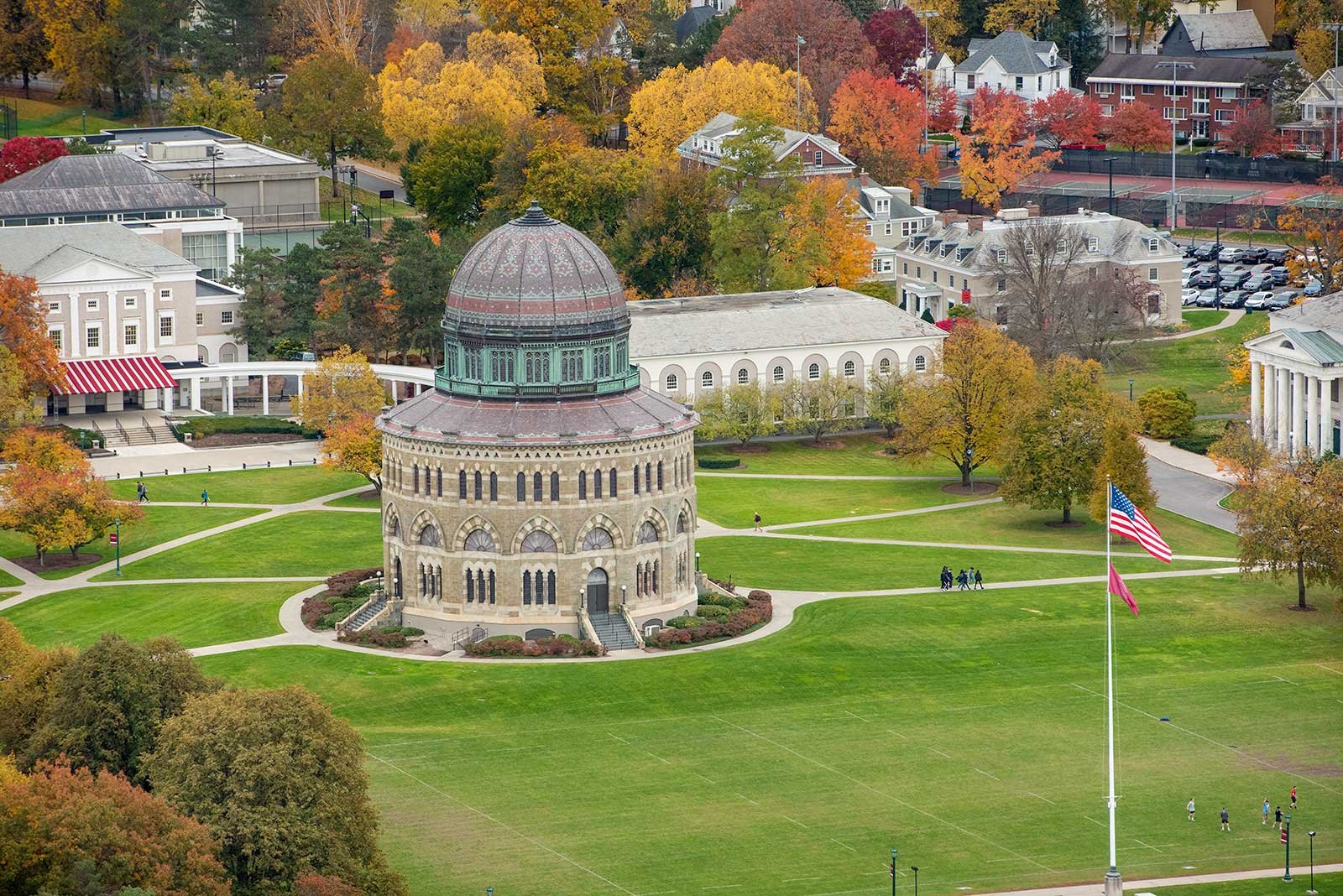
And Why the U.S. News Number Doesn’t Tell the Whole Story
A Data-Driven Look at Prestige, Engineering, ROI, and Career Outcomes
If you’ve ever searched “Union College ranking” or “is Union College good,” you’re not alone. Every admissions cycle, thousands of prospective students and parents try to figure out where Union College—the small liberal arts school tucked away in Schenectady, New York—fits in the broader landscape of elite undergraduate education. The short answer? It’s complicated, and it depends entirely on what you’re looking for.
Union is a founding member of the so-called “Little Ivies,” a group of highly regarded small colleges in the northeastern United States. Its peers include names like Williams, Amherst, Wesleyan, Hamilton, and Colgate—schools that routinely appear in the top twenty of every liberal arts ranking published. Union, meanwhile, sits at No. 44 in the latest U.S. News & World Report rankings for national liberal arts colleges. On the surface, that number might suggest Union is a tier below. But rankings are blunt instruments. They compress hundreds of variables into a single digit and, in the process, obscure the things that make individual colleges exceptional.
This matters because choosing a college is one of the most consequential financial and personal decisions a young person will make. Rankings offer a convenient shorthand, but they can also mislead. A student who dismisses Union because it’s “only No. 44” might be passing over a school where their specific goals—whether engineering, strong career placement, or an intimate campus culture—would be better served than at a higher-ranked institution that lacks those particular strengths.
This article digs beneath the headline number. Drawing on data from U.S. News, the Prestige Density Index, ABET accreditation records, Money magazine, Niche, and LittleIvyColleges.com, we examine where Union genuinely excels, where it trails its Little Ivy peers, and why a growing number of students—particularly those interested in engineering—are concluding that Union may be one of the most underrated colleges in America.
The Ranking in Context: What No. 44 Actually Means
Let’s start with the number everyone sees first. U.S. News & World Report’s 2026 edition places Union College at No. 44 among national liberal arts colleges, a slight slide from No. 40 the previous year. For families comparing spreadsheets, that four-position drop can feel significant. In practice, it’s almost certainly noise—the result of incremental changes in U.S. News’s weighting methodology rather than any meaningful decline in Union’s academic quality or student outcomes.
Union’s admissions data tell a more nuanced story. Official admissions statistics published in the Union College incoming class profile confirm application volume and enrollment trends for the most recent entering class For the Class of 2029, the college received 9,249 applications and admitted 4,019 students, yielding an overall acceptance rate of approximately 43 percent. Money magazine’s most recent profile lists a similar figure of 47 percent. Those numbers place Union in the “selective” category—not as exclusive as the single-digit admit rates at Williams or Amherst, but meaningfully more competitive than the vast majority of American colleges and universities. From that admitted pool, 465 students chose to enroll, giving Union a yield rate of about 11.6 percent and a total undergraduate enrollment of roughly 2,110 students.
It’s also worth noting that Union remains test-optional: 57 percent of applicants for the Class of 2029 did not submit standardized test scores. This policy broadens the applicant pool and makes direct comparisons with test-requiring institutions difficult. The takeaway is that Union’s selectivity is real, even if it doesn’t headline national rankings the way some of its Little Ivy siblings do.
The deeper issue with the U.S. News ranking is structural. The methodology is designed around broad liberal arts metrics—peer assessment, graduation rates, alumni giving, and financial resources—and tends to undervalue specialized strengths. A college that happens to be the only liberal arts school in the country with multiple ABET-accredited engineering programs doesn’t get extra credit for that distinction in a system built to compare English and economics departments. This is where alternative metrics become essential.
The Prestige Density Index: A Smarter Way to Compare
The Prestige Density Index, or PDI, was developed by LittleIvyColleges.com as a composite metric that attempts to capture per-student prestige rather than raw institutional reputation. It weights three variables: endowment per student, admissions selectivity, and undergraduate enrollment size. The logic is straightforward—a college with a large endowment, a small student body, and a low acceptance rate concentrates more resources and exclusivity per individual student. The methodology and dataset used to calculate the metric are described in the Prestige Density Index methodology report, which outlines how endowment per student, selectivity, and enrollment are weighted.
On the PDI, Union ranks 7th out of 18 Little Ivies, with a weighted average rank of 6.4 and a PDI score of 30.3. That places it just behind the usual suspects—Williams, Amherst, Bowdoin, and a handful of others—but comfortably ahead of several well-known peers. Union’s endowment per student sits at approximately $273,000, a figure that is respectable by any national standard but less than half the per-student endowment at Williams (which exceeds $700,000). Its undergraduate enrollment of about 2,065 and its approximately 44 percent admit rate round out the PDI profile.
What does 7th out of 18 mean in practical terms? It means Union occupies a solid middle-upper position among elite small colleges. It has enough financial resources to offer competitive financial aid, maintain small class sizes, and invest in facilities—but it doesn’t have the endowment firepower of the very top tier. This partly explains the gap between Union’s U.S. News ranking and its actual student experience. Resources per student drive many of the variables that U.S. News measures, from faculty salaries to student services. Union is fighting above its financial weight class, which makes its outcomes all the more impressive.
Engineering: Union’s Defining Advantage
If there is a single factor that sets Union College apart from every other Little Ivy, it is engineering. Union is the only Little Ivy that offers multiple four-year, on-campus, ABET-accredited engineering programs integrated into a liberal arts curriculum. That sentence deserves emphasis because it represents a category of one.
Union pioneered engineering education among liberal arts colleges, establishing its first programs in the 1840s—decades before ABET accreditation even existed. Today, the college offers fully accredited programs in biomedical engineering, computer engineering, electrical engineering, and mechanical engineering. Students don’t need to transfer, apply to a partner university, or complete a dual-degree program. They start engineering coursework from day one and graduate with a bachelor’s degree from Union—all while benefiting from the small class sizes, close faculty mentorship, and interdisciplinary breadth of a liberal arts education. All four programs are formally confirmed through the ABET accredited engineering program database, which lists Union College’s biomedical, computer, electrical, and mechanical engineering degrees as fully accredited.
This is a critical distinction. Most peer colleges—Hamilton, Colgate, Vassar, and others—offer engineering access only through 3–2 dual-degree partnerships with research universities. In those arrangements, a student spends three years at the liberal arts college studying a general curriculum, then transfers to an engineering school (often Columbia or Dartmouth’s Thayer School) for two additional years, eventually earning two degrees. While these programs have merit, they require students to leave their campus community, extend their time to graduation, and navigate two distinct institutional cultures. Union’s model avoids all of that.
The numbers back up the investment. U.S. News ranks Union’s undergraduate engineering program 21st out of 291 schools where the highest degree offered is a bachelor’s or master’s. The Princeton Review ranks Union’s science lab facilities No. 3 in the nation. The engineering complex itself includes a 35,000-square-foot facility and a 6,500-square-foot machine shop, reflecting the kind of capital commitment typically associated with much larger universities.
On the LittleIvyColleges.com engineering access scorecard, Union earns a perfect 100 and ranks first among all 18 Little Ivies. Every other school in the group scores 50 or below. For any prospective student who wants an engineering degree from a small, prestigious liberal arts college without the complexity of a dual-degree arrangement, Union is—quite literally—the only option.
The implications for students considering this path are profound. At a 3–2 partner school, an aspiring engineer spends three years taking primarily non-engineering courses, transfers to an unfamiliar campus for two more years of intensive technical study, and graduates with two degrees but little of the cohesive undergraduate experience that draws students to small colleges in the first place. At Union, the same student takes engineering courses alongside philosophy seminars, plays on varsity teams for four continuous years, builds relationships with the same faculty mentors throughout, and graduates with a single, accredited degree from an institution they called home the entire time. The difference in lived experience is enormous, even when the academic credentials look similar on paper.
Union’s biomedical engineering program deserves special mention. BME is one of the fastest-growing fields in higher education, and Union is the only Little Ivy offering a four-year, on-campus, ABET-accredited biomedical engineering major. Students in the program have access to the same state-of-the-art facilities, the same 9:1 student-to-faculty ratio, and the same liberal arts breadth as their peers in other disciplines. For a student who wants to study biomedical engineering in a small-college environment, Union is not merely the best choice among Little Ivies—it is the only choice. Program structure, facilities, and curriculum details are outlined on the Union College engineering programs overview.
Mid-Career Earnings: Union vs. Little Ivy Peers
Median earnings 10 years after entering college
Sources: LittleIvyColleges.com ROI dataset • U.S. Department of Education College Scorecard • Money Best Colleges. Colgate, Hamilton, Wesleyan & Vassar figures are approximate composites from public datasets for illustrative comparison.
Union College at a Glance
Key metrics from U.S. News, Money, Niche & LittleIvyColleges.com
| Metric | Value |
|---|---|
| U.S. News Ranking (2026) | No. 44 — National Liberal Arts Colleges |
| Acceptance Rate | 43–47% |
| Undergraduate Enrollment | ~2,110 students |
| Student-to-Faculty Ratio | 9 : 1 |
| PDI Rank (Little Ivies) | 7th of 18 |
| Endowment Per Student | ~$273,000 |
| Engineering Ranking | 21st of 291 (bachelor’s / master’s) |
| Engineering Access Score | 100 — 1st among Little Ivies |
| Median Earnings (10 yrs) | $88,604 |
| ROI Score | 45.9 |
| Average Net Price | ~$36,000 |
| 6-Year Graduation Rate | 86–87% |
| Employment Rate (1 yr) | 95% |
Sources: U.S. News 2026 • Union College Admissions • LittleIvyColleges.com • Money • Niche • ABET
Return on Investment: Following the Money
College is an investment, and increasingly, families want to know what kind of return that investment yields. Union performs remarkably well on this front. According to the ROI dataset compiled by LittleIvyColleges.com, Union graduates earn a median salary of $88,604 ten years after entering college. That figure is virtually identical to Williams ($88,665) and only slightly below Bucknell ($93,807)—two schools that consistently rank higher in U.S. News. Union’s ROI score of 45.9 places it in the top tier among Little Ivies, reflecting a strong ratio of post-graduation earnings to cost of attendance.
Other sources corroborate these findings. Money magazine reports that 87 percent of Union students graduate within six years and that recent graduates earn a median starting salary of approximately $75,000. Niche’s data shows earnings of $51,306 one year after graduation and $80,426 five years after graduation, with a 95 percent employment rate within one year of completing a degree. These are not the numbers of a school languishing at No. 44—they are the numbers of a college whose graduates are highly employable and well-compensated. Federal outcome data reported through the U.S. Department of Education College Scorecard similarly shows strong graduation rates, earnings performance, and post-graduation employment outcomes for Union College alumni.
Union’s average net price (cost after financial aid) is approximately $36,000, which is mid-range among Little Ivies. The college offers both need-based and merit-based financial aid, making it accessible to a broader range of families than its sticker price might suggest. When you divide mid-career earnings by net cost, Union’s value proposition becomes clear: students are paying a moderate price and receiving career outcomes that rival those of far more expensive and supposedly more prestigious institutions.
The engineering factor almost certainly plays a role here. Engineering graduates tend to command higher starting salaries than their peers in the humanities or social sciences, and Union’s strong placement in technical fields pulls the entire earnings distribution upward. But it’s not just engineers who benefit. Union’s liberal arts graduates also report strong outcomes, thanks in part to the college’s career center (rated helpful by 93 percent of students surveyed by Niche) and an alumni network that 97 percent of students describe as strong.
The Student Experience: Small by Design
Numbers only tell part of the story. What is it actually like to attend Union College? Several features define the experience.
First, the student-to-faculty ratio is 9:1—one of the lowest in the country. At that ratio, classes are genuinely small, professors know students by name, and undergraduate research opportunities are abundant. More than a quarter of Union students study more than one discipline, reflecting the college’s trimester calendar and flexible curriculum, which make it easier to double-major or pursue interdisciplinary minors across more than sixty programs.
Second, Union’s Minerva House system creates a distinctive residential experience. Students are assigned to one of seven residential communities that serve triple duty as living spaces, classrooms, and social lounges. First-year discussion sessions often take place within these houses, blurring the line between academic and social life in a way that reinforces the college’s tight-knit culture. The system is intentionally designed to foster belonging and intellectual community from the moment students arrive on campus.
Third, the alumni network punches well above what you might expect from a school of 2,100 undergraduates. Union’s graduates include a U.S. President (Chester A. Arthur), an Olympic champion (Nikki Stone), and prominent figures in entertainment, business, and public service. The college’s alumni are notably loyal—a trait that translates into strong mentorship pipelines, recruiting connections, and philanthropic support.
The data on career preparation reinforces this picture. According to Niche, 97 percent of Union students believe the alumni network is strong, and 93 percent found the career center helpful—figures that would be impressive at any institution. Combined with the 95 percent employment rate within one year of graduation, these numbers suggest that Union’s small size is not a limitation but a feature: fewer graduates means tighter networks, more personalized career guidance, and stronger per-student connections to employers and graduate programs.
For students who thrive in close communities and value knowing their professors, classmates, and career advisors personally, Union’s scale is an asset that larger or even comparably-sized institutions struggle to replicate. The trimester system adds additional flexibility, allowing students to take a wider range of courses than they might under a traditional semester calendar, and giving them the freedom to explore interests outside their major without falling behind on degree requirements.
Where Union Trails Its Peers
No analysis is complete without acknowledging weaknesses, and Union has areas where it lags behind the top Little Ivies.
The most significant gap is financial. Union’s endowment per student of roughly $273,000 is healthy by national standards but less than half the figure at Williams or Amherst, where per-student endowments exceed $700,000. This disparity has downstream effects: it limits the size of financial aid packages, constrains faculty hiring, and reduces the college’s ability to invest in new programs and infrastructure relative to its wealthiest peers. For students choosing between Union and a top-five Little Ivy with a comparable or lower net price, the financial resources gap is real.
The acceptance rate is another area of relative weakness. At 43 to 47 percent, Union is selective—but it’s not in the same selectivity bracket as schools admitting fewer than 15 percent of applicants. In the world of college rankings, selectivity is a powerful signal, and Union’s admit rate keeps it from climbing higher on lists that reward exclusivity.
Finally, Union’s six-year graduation rate of 86 to 87 percent is solid but trails the 90-plus percent rates common at the most elite liberal arts colleges. This metric feeds directly into U.S. News rankings and, along with the endowment and selectivity gaps, helps explain why Union sits at 44 rather than in the top twenty. Institutional resource levels, admissions selectivity, and graduation outcomes reported in the U.S. News & World Report Union College statistical profile illustrate the financial and selectivity gaps that contribute to ranking differences among leading liberal arts colleges.
It is also fair to note that Union’s location in Schenectady, New York, lacks the cachet of a college town like Williamstown or a city like Providence. For some students, campus setting is a meaningful factor, and Schenectady—while undergoing revitalization—does not offer the same walkable charm or cultural density as some competitor locations. That said, the college’s campus itself is widely regarded as beautiful, and its proximity to Albany, the Adirondacks, and major northeastern cities provides students with meaningful off-campus options.
None of these weaknesses are fatal. They are the kinds of trade-offs that every college outside the very top tier faces. The question for any individual student is whether Union’s distinctive strengths—engineering, ROI, faculty access, residential community—outweigh its relative disadvantages in endowment and selectivity. For many students, particularly those with technical interests, the answer is clearly yes.
Little Ivy Engineering Access Scorecard
Can you earn a four-year, ABET-accredited engineering degree on campus?
Union College
Multiple on-campus ABET-accredited majors • Start engineering Day 1 • U.S. News #21 engineering
Hamilton
3–2 program with Columbia / Dartmouth Thayer
Colgate
3–2 program with Columbia / Washington U.
Vassar
3–2 program with Dartmouth Thayer
Wesleyan
3–2 with Caltech / Columbia / Dartmouth
Sources: LittleIvyColleges.com Engineering Access dataset • ABET Accreditation Records • Individual college catalogs. Scores of ≤50 indicate reliance on 3–2 dual-degree transfer programs rather than on-campus accredited engineering majors.
The Bottom Line: A College That Punches Above Its Weight
Union College’s U.S. News ranking of 44 is a fact, but it is not the whole truth. Within the Little Ivy framework, Union occupies a distinctive position: 7th in per-student prestige, first in engineering access, and competitive with top-ten peers on career outcomes and return on investment. Its graduates earn mid-career salaries that rival those of Williams and Bucknell. Its engineering programs are nationally ranked and uniquely integrated into a liberal arts setting. Its student experience—defined by a 9:1 faculty ratio, the Minerva House system, and a loyal alumni network—is genuinely differentiated.
The areas where Union trails are real but contextual. A smaller endowment and a higher acceptance rate keep it from competing with the very wealthiest and most selective schools on the metrics that U.S. News rewards. But those same metrics fail to capture what makes Union unusual: the ability to earn a fully accredited engineering degree at an intimate liberal arts college, surrounded by students studying everything from philosophy to neuroscience, with faculty who know your name and a career center that delivers results.
For prospective students—especially those interested in engineering, strong career outcomes, and a close-knit campus community—Union offers something that no ranking can fully quantify. It is a college built on the premise that technical rigor and liberal arts breadth are not opposites but complements. And for a growing number of families doing the math on college value, that combination is hard to beat.
The next time someone asks “is Union College good?”, the answer is not a ranking. It’s a question back: good at what? If the answer is engineering at a liberal arts college, career preparation, return on investment, or building a life of intellectual range—then Union isn’t just good. It’s one of the best options in the country
Sources:
U.S. News & World Report — Union College Profile
https://www.usnews.com/best-colleges/union-college-2899Union College — Incoming Class Profile
https://www.union.edu/admissions/resources-for-counselors/incoming-class-profileU.S. Department of Education — College Scorecard (Union College)
https://collegescorecard.ed.gov/school/?196866-Union-CollegeABET — Accredited Program Search
https://amspub.abet.org/aps/name-search?searchType=institutionUnion College — Engineering Programs
https://www.union.edu/engineeringCollege Board BigFuture — Union College Admissions Data
https://bigfuture.collegeboard.org/colleges/union-college-schenectady-nyMoney Magazine — Best Colleges Profile (Union College)
https://money.com/best-colleges/profile/union-college/Niche — Union College Profile
https://www.niche.com/colleges/union-college/NCES College Navigator — Union College
https://nces.ed.gov/collegenavigator/?q=Union+College&s=all&id=196866NACUBO-TIAA Study of Endowments (Higher-Education Endowment Data)
https://www.nacubo.org/Research/2024/NACUBO-TIAA-Study-of-Endowments